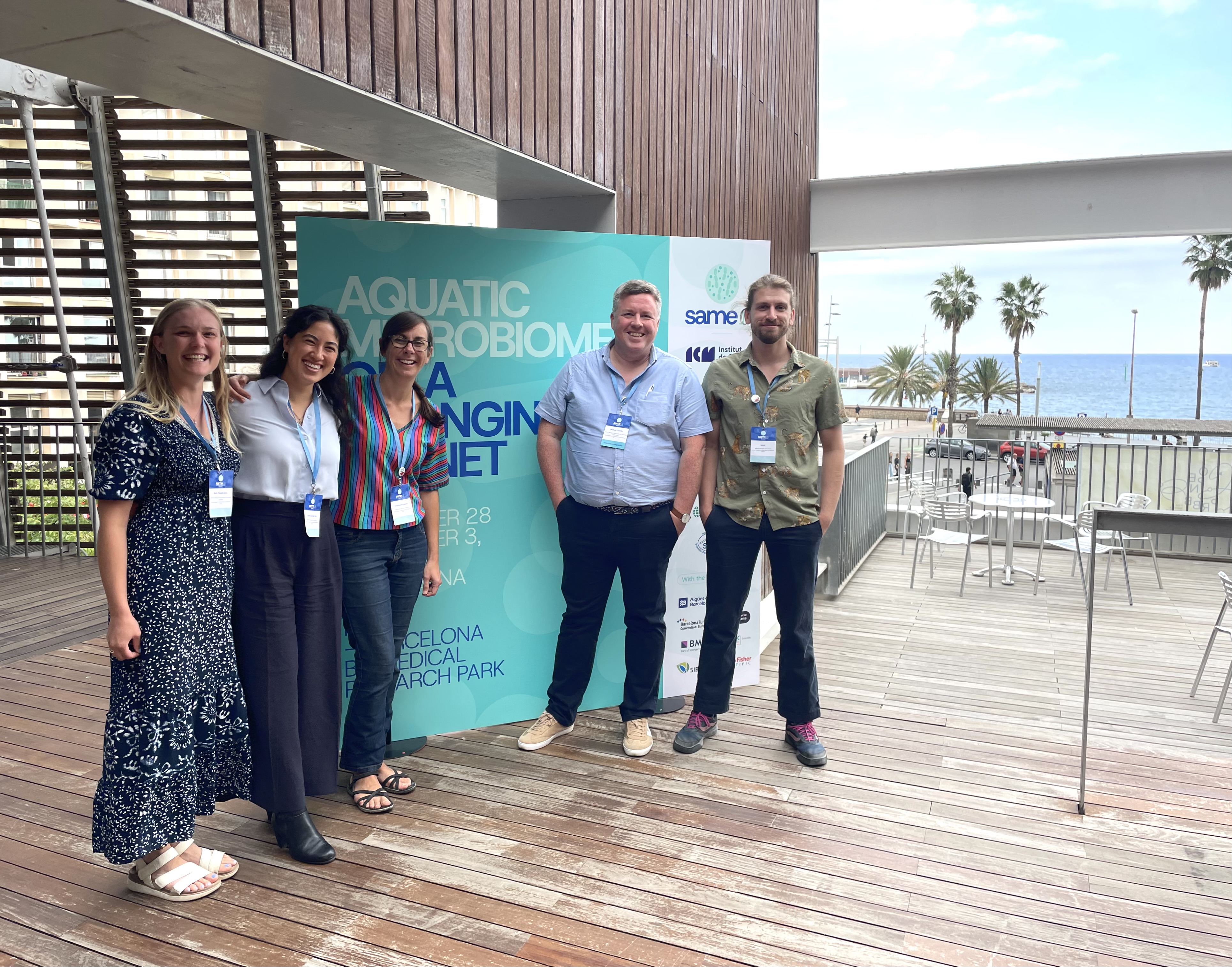
18th Symposium of Aquatic Microbial Ecology (SAME18) in Barcelona, Spain
University of Plymouth and Marine Biological Association
Thanks to the Challenger Society’s support, I had the opportunity to attend the 18th Symposium of Aquatic Microbial Ecology (SAME18) in Barcelona, Spain. Coinciding with the end of my first year as a PhD student, this event marked an exciting milestone in my research journey. The week was filled with inspiring talks and stimulating discussions, serving as a fantastic introduction to the international aquatic microbial community!
Though my peers had warned me, I hadn’t fully appreciated how jam-packed conferences could be. Each day was filled with talks, poster sessions, social outings, and cultural events. Not only did I learn about cutting-edge research in my field, but also the rich history of Barcelona.


Conference location (PRBB; top left), Basílica de la Sagrada Família (top right), welcome talk (bottom left) and a ‘castel’ – a human pyramid traditionally built during festivals in Catalonia (bottom right)
I presented my research on the diversity patterns of parasites infecting marine diatoms, using a long-term environmental DNA (eDNA) dataset from Station L4 off the coast of Plymouth, UK. My poster highlighted a method we’re developing to validate parasite eDNA data, along with key findings from my first year of analysis. The session led to stimulating conversations with researchers from related fields and inspired new ideas for future work.

While a conference on aquatic microbial ecology sounds niche, the breadth of topics covered was remarkable. Presentations ranged from the study of worm microbiomes to the application of machine learning in predicting bacterial traits. It was a great way to learn about topics outside of my research focus and new tools being employed to study aquatic microbes. I particularly enjoyed the session on flow cytometry, a technique that uses lasers to study individual cells or particles. One researcher was even using it to distinguish between active and inactive viruses – something I didn’t even realise was possible!
By far my favourite part of the conference was the networking. It was a pleasure to meet the scientists whose work I had been reading, see familiar faces from previous conferences, and share knowledge and ideas with other researchers at various stages of their careers. I also thoroughly enjoyed the talks from keynote speakers, particularly from Prof. Sarah Hu and Prof. Justin Seymour. Both had incredibly creative approaches to scientific enquiry, and it was fascinating to hear about the inspiration behind their work.

SAME is a long-standing conference series covering all aspects of aquatic microbial ecology. As my research explores microbial interactions using a diverse set of analytical tools, this was the perfect event to attend before diving into my second year. I’ve learned so much in such a short period of time and am excited to pursue new ideas and collaborations inspired by this experience. It is truly an honour to be part of such a great community.
Thank you again to the Challenger Society for making this possible – I will look back fondly on this for the rest of my career.
Awardee Profile:
Caitlin Kumiko Dye is a PhD student at the Marine Biological Association with the University of Plymouth. Her work explores the interactions between marine diatoms, bacteria, and parasites using a range of lab- and field-based techniques. Caitlin is a passionate scientific communicator, partaking in outreach events and editing for the ARIES DTP SCIENVY blog.
Leave a Reply