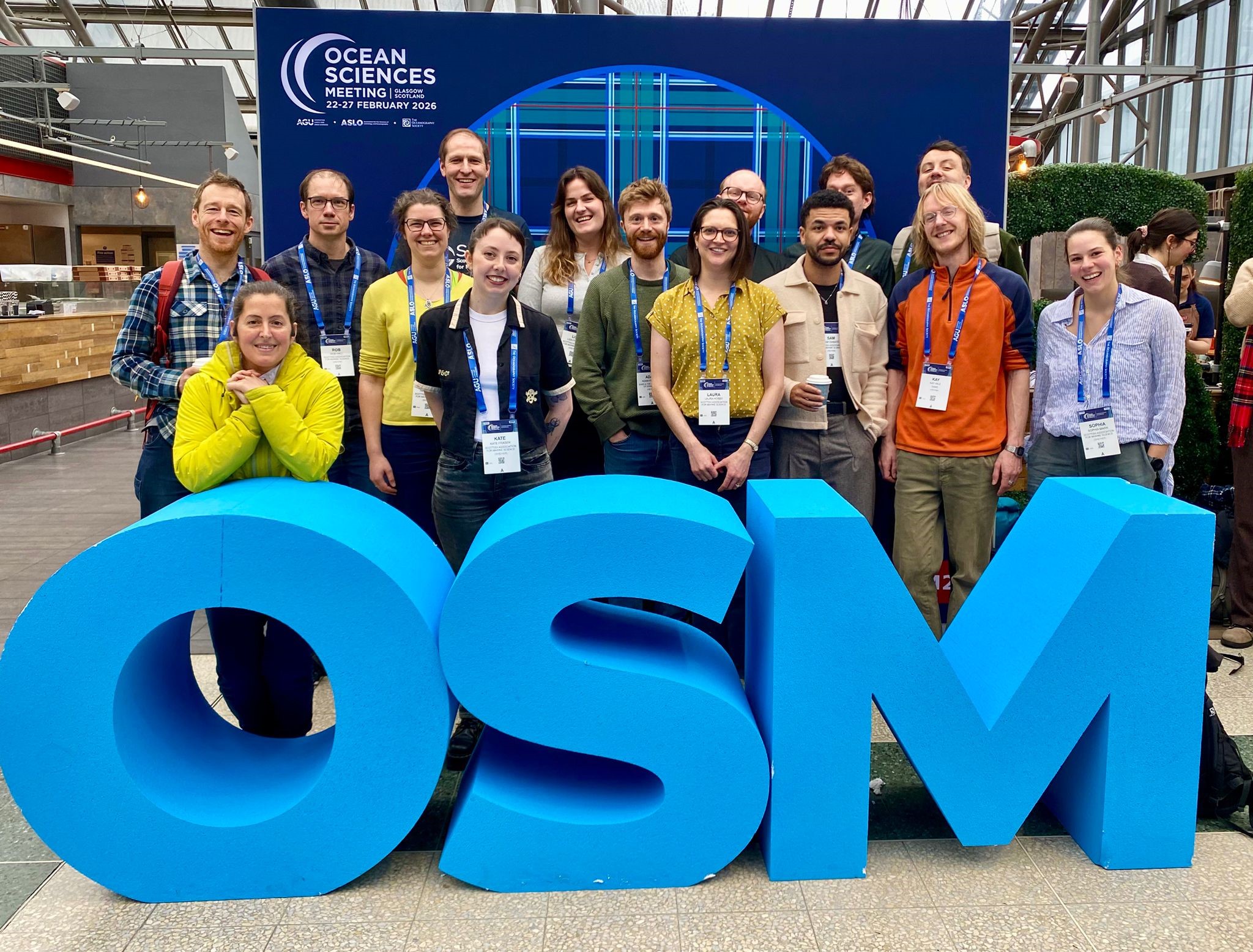
Attending the Ocean Sciences Meeting 2026 in Glasgow
Scottish Association for Marine Science
In February, I attended the first Ocean Sciences Meeting to be held outside the USA, in Glasgow, Scotland. This was by far the biggest conference I had ever attended, with over 6000 attendees crammed into the Scottish Exhibition Centre for a week of diverse scientific discussions and knowledge transfer. The Challenger Society’s travel grant allowed me to present my poster and expose my PhD research to a very large audience. Despite being held in my home country, I would not have been able to cover the costs of attending without the help of the Challenger Society, and I am extremely grateful!

The first day was a bit of a blur. I had just come back from a two-week workshop in Germany and had to immediately make my way to Glasgow so I could be ready bright and early Monday morning. Unfortunately, I had been ill over the last week and had some flight cancellation chaos, so “bright” was not the correct term. The bustling SEC was a little overwhelming at first, but thankfully, I had been organised and made a meticulous timetable before I left for Germany. This was essential as I was used to conferences with two parallel sessions to choose from, but the OSM was sporting up to sixteen at any given time. The SEC was fully used, with many rooms across campus, and there was limited time to get to them through the crowds (I was reaching 10k steps a day without leaving the conference)!

The first thing I did was pick up my poster and hang it up in the football stadium-sized poster hall. I would’ve needed the whole week just to see every poster, but I made a note of the specific ones I wanted to see. With the chaos of the first day, I realised I didn’t see anyone I knew at all, so I made a point of getting a full night’s sleep, and I would actively find familiar faces in the coming days.
The deep-sea community was well represented during the next couple of days, so I had plenty of sessions to attend. I managed to catch up with many deep ocean researchers whom I hadn’t seen in a while. On Tuesday, I went to an exciting lunch session announcing a 10-year programme to study seamounts, bringing together international researchers and institutions. Wednesday was the most deep-sea-heavy day, with a deep-ocean research town hall featuring many interesting updates from the field. I was also impressed with the facilitation of capacity-building conversations that were held with many researchers from developing countries, making their voices heard. Great care and time were taken to bring in native voices to speak about their own deep-sea ecosystems. This is extremely important as deep-sea research has been mostly carried out by a handful of institutions in the global north. That being said, the price of the conference and the fact that it has only been held in the US and UK (the next will be in Canada) should be taken into account by the organisers if they want to encourage researchers to attend from the global south.


Pic 3- “Sealia” the MASTS exhibitor offering me a nice teacake and Pic 4- The OSM mascot sporting the tartan specifically made for the conference
On the final day, I attended more talks and an eLightning talk, where speakers very rapidly presented poster-style presentations. This was a very fun session discussing deep-sea exploration, genetic diversity and species discovery at abyssal depths and how many taxonomic revisions and resurrections, even at the family level, are happening thanks to museum collections.

Overall, I had a great time at the OSM26. Of course, I learned a lot at the various talks from marine art to oceanography to ecology. I felt very inspired by the science communication talks I attended, and those discussing early years education to encourage children to pursue STEM careers. And I am more determined than ever to be a useful part of the small but thriving international deep-sea community. Thank you again to the Challenger Society for allowing me to attend and letting my voice be heard.
Awardee Profile:
I am a 3rd year PhD student at the Scottish Association for Marine Science (SAMS). My research focuses on how deep-sea macrofaunal benthic communities have changed since 1980, using a Rockall Trough seabed time-series paired with surface environmental data to possibly explain any changes seen in the fauna and how connected the deep is to the surface. I am also very interested in invertebrate taxonomy, species discovery and how climate change is affecting the deep ocean.
Leave a Reply