2026 the International Glaciological Society Meeting
University of Cambridge and British Antarctic Survey
The Challenger Society Stepping Stones Bursary enabled me to travel to the United States in July 2026 to attend both the International Glaciological Society Meeting on Ice-Ocean Interactions in San Diego and NASA’s Ai4Ocean Workshop in Seattle. This travel grant has enabled new collaborations and grown my international network, has allowed me to conduct dedicated work on a new project that I’ve been able to turn into several grant and fellowship proposals and help me secure a postdoctoral job based off the new skills acquired from this work.

The IGS meeting in mid-July was a week-long conference hosted at Scripps Institute of Oceanography on the sunny shores of La Jolla. With around 100 attendees, the conference spanned Arctic and Antarctic science and a wide range of topics; all trying to understand ice-ocean interactions and the feedback mechanisms at play. I presented a poster of some preliminary work that I’ve been conducting since my PhD submission on the potential of NASA’s new satellite mission SWOT (Surface Water Ocean Topography) to observe ice mélange in the rifts of Thwaites’ Glacier Tongue as well as its surrounding sea ice and open water. My work was well-received, and I met several new colleagues that gave me many ideas on how to move the project forward.
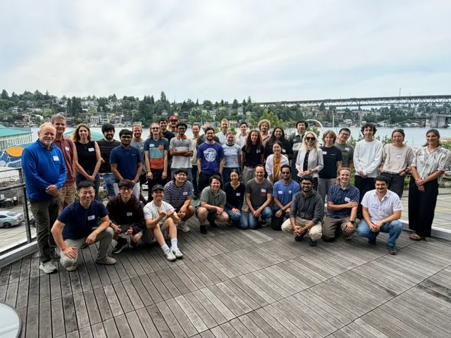
Directly off the back of the IGS meeting, I was also able to also attend a 2-week workshop at the University of Washington, Seattle on AI tools for ocean observation using NASA’s new missions SWOT and PACE. The workshop was attended by approximately 30-40 participants, ranging from early career research students to mid-to-late career stage research professionals, which promoted great discussions of problems and ideas. After an introduction to the math behind machine learning and the different available architectures, we broke up into several groups to carry out a mini project using machine learning to tackle our chosen problems.


I was inspired after meeting several people at IGS to create my own project to work on during this workshop which would explore the use of machine learning to correct the phase unwrapping errors that are prolific in the SWOT data over Thwaites Glacier. The collation and cleaning of the training data was arduous, but I was ultimately successful at the end of the two weeks in implementing a basic random forest model to identify these errors in the SWOT data. The promising first results of this work has borne further fruit in that I’ve been able to scope a larger project for a couple of fellowships and grants that will look at this problem in further detail. Furthermore, I hope to be able to write up this preliminary work with my new collaborators, into a small research paper for publication in the next few months.
Ultimately the Stepping Stones Bursary has played a large role in allowing me to pursue a new research project and helped forge new connections for future collaboration. The skills learnt during this time also played a part in helping me secure a postdoctoral job at the Scripps Institute of Oceanography, which I hope to start soon.

Awardee Profile:
Siobhán Johnson has just completed her PhD at the University of Cambridge and British Antarctic Survey. Her research interests are diverse but center around Antarctic sea ice and its variability. She has participated in five international field campaigns to the Antarctic and led the sea-ice sampling teams onboard for three of those campaigns. She will be begin a postdoctoral research position at Scripps Institute of Oceanography, University of California San Diego in the coming months which will investigate Antarctic Bottom Water formation, its circulation and how freshwater input from glacier melt may inhibit these processes.