BESMove2026 British Ecological Society Movement Ecology Annual Meeting: Movement Dynamics in a Changing World
Swansea University
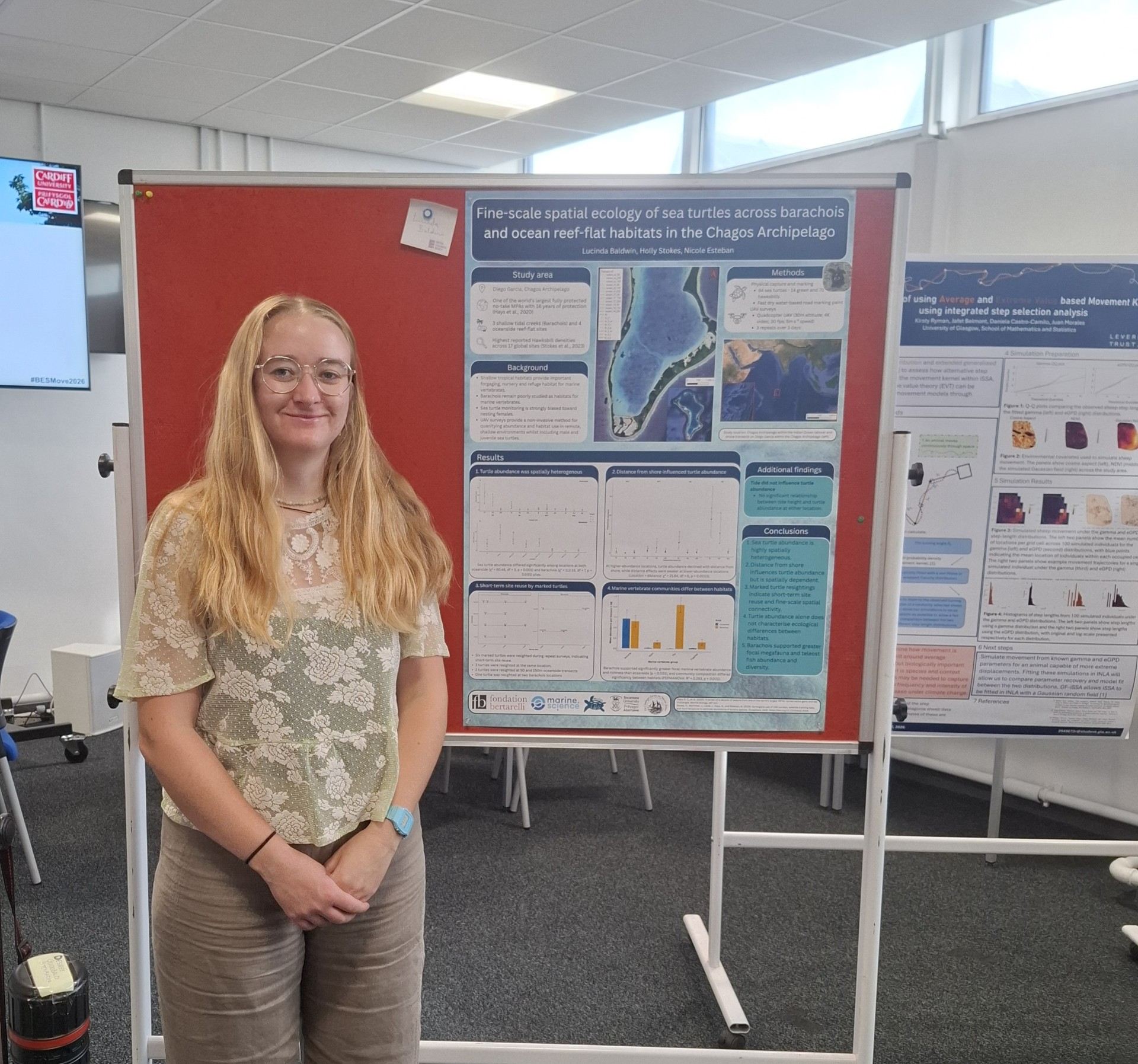
On 2–3 September 2026, I attended the Movement Ecology Annual Meeting (BESMove2026) at Cardiff School of Biosciences. This year’s theme, Movement Dynamics in a Changing World, brought together researchers studying animal movement across a wide variety of species and environments.

I attended the meeting to present a poster based on my MSc research at Swansea University, which investigates the biodiversity and ecological importance of barachois habitats: shallow tidal lagoons within Diego Garcia Atoll in the Chagos Archipelago. My research uses UAV surveys to investigate the abundance and fine-scale spatial distribution of sea turtles and other marine vertebrates across barachois and neighbouring ocean reef-flat habitats.

One of my favourite parts of the meeting was hearing from researchers who had travelled to Cardiff from across the world, including Africa, Brazil, India and Australia. I was particularly fascinated by the huge variety of different methods being used to tag and track animals. These ranged from backpack-style tags fitted to birds and frogs, to tracking collars used on antelopes and incredibly small transmitters attached to dragonfly abdomens. Seeing how researchers had adapted tracking methods to animals of very different sizes and behaviours introduced me to approaches that I had never encountered before.

The meeting’s focus on animal movement in a changing world was also particularly relevant to my wider interests in conservation. Understanding how animals alter their movements, habitat use and behaviour in response to changing climates and environments is increasingly important for determining where conservation efforts should be directed in the future. Throughout the meeting, it was interesting to see how movement data is being used not only to understand animal behaviour, but also to address practical questions around biodiversity monitoring and conservation management.

Awardee Profile:
Lucinda Baldwin is an MSc Marine Restoration and Conservation student at Swansea University. Her current research investigates the biodiversity and ecological importance of barachois, shallow tidal lagoons within Diego Garcia Atoll in the Chagos Archipelago. Using UAV surveys, she is examining the abundance and fine-scale spatial distribution of sea turtles and other marine vertebrates across barachois and neighbouring ocean reef-flat habitats. Her wider research interests include community-led conservation as well as marine and coastal habitat restoration.
Leave a Reply