Research Visit to the Norwegian Polar Institute and Participation in the 2025 A-DBO Meeting
University of Edinburgh
I would like to thank the Challenger Society for Marine Science and the Scottish Alliance for Geoscience, Environment and Society (SAGES) for supporting my research visit to the Norwegian Polar Institute (NPI) in Tromsø in December 2025. Although I had previously undertaken a research visit to NPI, this was my first time working there during the polar night, which made the experience particularly exciting. Taking place at a key point in the final stage of my PhD, the visit proved both scientifically valuable and professionally rewarding.
Upon arrival, I gave a departmental seminar at NPI, where I presented results from my PhD research on long-term changes in Arctic Ocean nitrogen biogeochemistry, focusing on nitrate isotope time series from the Fram Strait Arctic Outflow Observatory programme. The audience included researchers from physical, chemical, and biological oceanography as well as sea-ice science, and the discussion that followed was wide-ranging and constructive. That same day, I also held focused meetings with long-standing collaborators Dr Paul Dodd and Dr Laura de Steur, who lead the Fram Strait Arctic Outflow Observatory programme. These discussions were highly productive and supported progress on two manuscripts, one currently under review and another in preparation.

Over the following days, I attended and presented at the annual Atlantic–Arctic Distributed Biological Observatory (A-DBO) meeting (10–11 December 2025). The small size of the meeting fostered an open and collegial atmosphere, making it easy to engage with participants and closely follow new results that are directly relevant to my current work. I particularly valued seeing the behind-the-scenes coordination within the A-DBO framework, including how priorities are agreed, observations aligned across regions and disciplines, and sampling and data workflows organised to sustain long-term time series and data sharing across institutions.
On my final day, I collected the Fram Strait Observatory FS2025 frozen nitrate isotope samples from the most recent summer expedition and transported them back to Edinburgh for analysis. This ensured continuity of the long-term dataset that underpins my PhD research and provided a fitting conclusion to the visit.
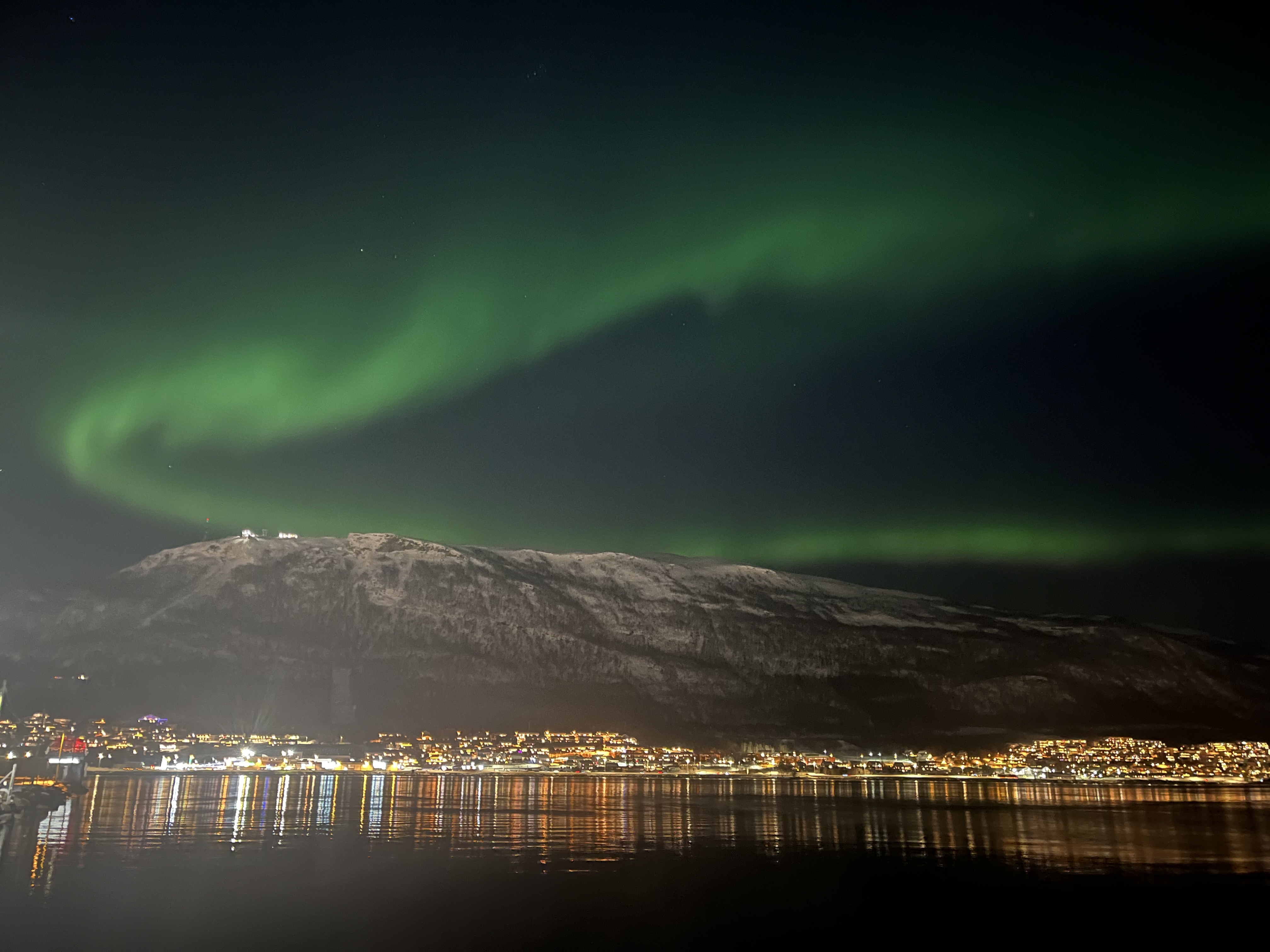
On a more personal note, I also had the opportunity to see the northern lights on several occasions during the trip, including one evening after the conference dinner and again on the flight home.

Experiencing the aurora during the polar night was a memorable complement to an otherwise focused and productive visit. Overall, the trip provided an opportunity to further consolidate collaborations, advance ongoing research, and prepare for the final phase of my PhD. I look forward to continuing many of these discussions with colleagues at the Ocean Sciences Meeting in Glasgow.
Awardee Profile:
I am Marta Santos García, a final-year PhD student at the University of Edinburgh funded by the NERC E4 DTP, specialising in polar marine biogeochemistry. My research examines the fate of nutrients in the rapidly changing Arctic Ocean, integrating chemical and physical oceanography through field observations, nitrate isotope laboratory analyses and modelling approaches.
My doctoral research identifies a sea ice loss-driven shift in Arctic nitrogen biogeochemistry and quantifies nitrate loss within the Arctic halocline using isotopic constraints. Together, these long-term time series analyses demonstrate how sea-ice decline and circulation changes are reshaping pan-Arctic nutrient cycling, with large scale ecological implications.