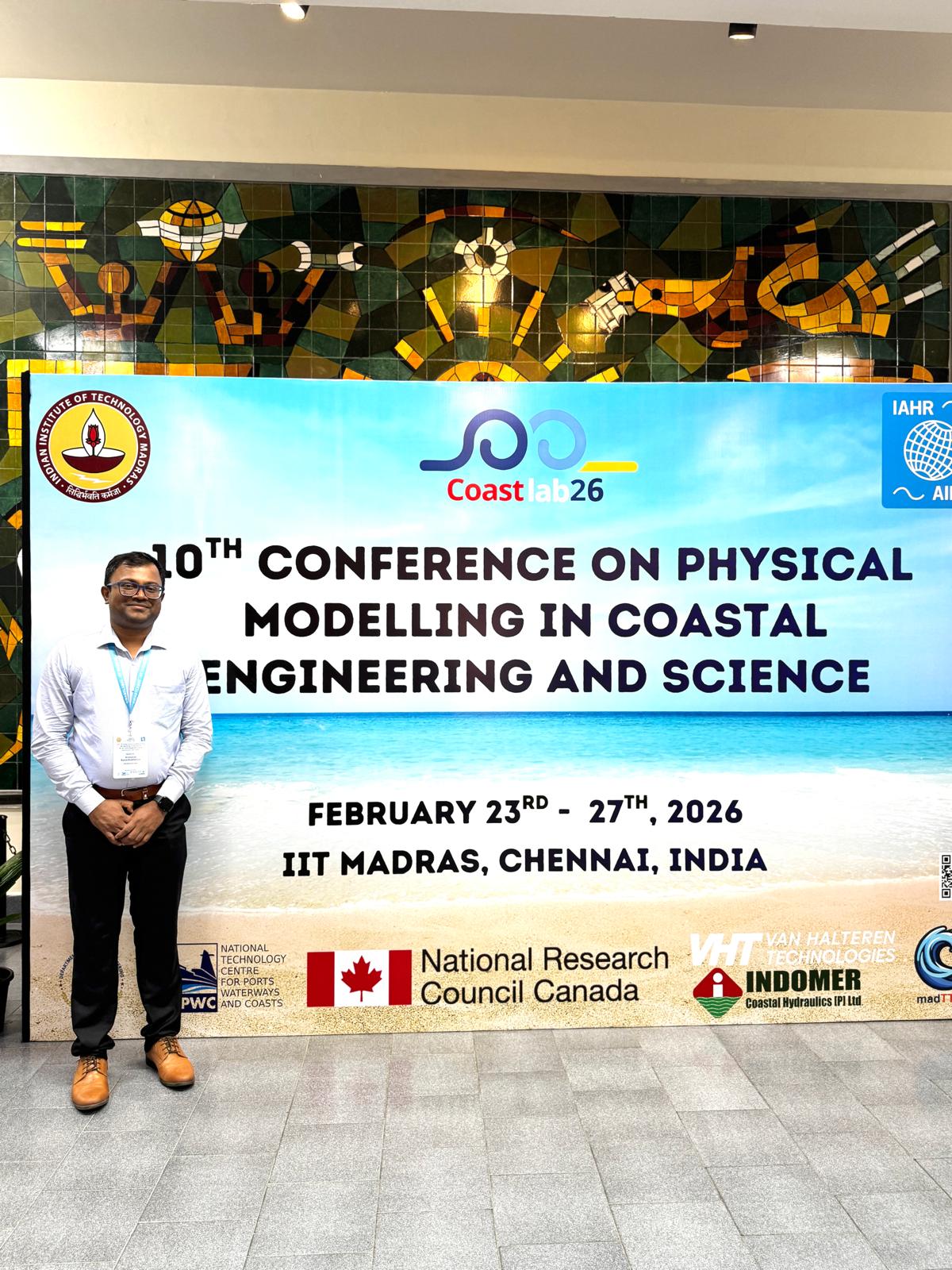
Attendance and Presentation at CoastLab 26 (10th Conference on Physical Modelling in Coastal Engineering and Science), IIT Madras, India
University of East London
I had the opportunity to attend the CoastLab 26 (10th Conference on Physical Modelling in Coastal Engineering and Science) held at the Indian Institute of Technology (IIT) Madras, Chennai, India, from 23rd – 27th February 2026. CoastLab is an internationally recognised conference dedicated to laboratory and experimental research in coastal engineering, bringing together researchers working on coastal hydrodynamics, sediment transport, coastal hazards, and infrastructure resilience.

I am currently a PhD researcher in Coastal Engineering at the University of East London. My research focuses on tsunami-induced scour around coastal defence structures, particularly the transient and equilibrium scour processes occurring on the landward side of vertical seawalls subjected to tsunami overflow.
My PhD research is part of an international collaboration between the University of East London (UK) and the University of Michigan (USA), supported by funding from the Royal Society. As part of this collaboration, I conducted a series of hydraulic laboratory experiments at both institutions to investigate scale effects on tsunami-induced plunging jet scour processes.
The experiments were performed using dam-break generated solitary bore waves in hydraulic flumes at the University of East London and the University of Michigan. These experiments simulate tsunami overflow conditions impacting vertical seawalls and allow investigation of how laboratory scale influences the development of maximum scour depth and equilibrium scour depth.
At CoastLab 26, I presented my research titled “Experimental Investigation of Scale Effects on Tsunami-Induced Plunging Jet Scour at Vertical Seawalls.” The study compares experimental results obtained from two hydraulic flume facilities with different scales: the 8.6 m flume at the University of East London and the 16 m flume at the University of Michigan.

The objective of the research is to investigate whether laboratory-scale experiments can reliably predict prototype scour behaviour around coastal defence structures. Although larger absolute scour depths were expected in the larger facility due to geometric scaling, the experiments revealed systematic scale effects in scour development even when Froude similarity was maintained. In particular, dimensionless scour depths did not collapse between the two facilities, indicating that laboratory scale influences scour processes beyond simple geometric and hydraulic similarity.
Presenting this research at CoastLab 26 provided an excellent opportunity to share the findings with the international coastal engineering research community. The conference attracted researchers from universities, research institutes, and engineering organisations around the world.
The discussions following my presentation were particularly valuable. Several researchers provided insights regarding scaling effects, sediment transport processes, and potential implications for coastal design standards. These interactions helped refine ideas about how laboratory results can be better interpreted and applied to real-world coastal infrastructure problems.
In addition to presenting my research, I attended a wide range of technical sessions covering wave-structure interaction, sediment transport processes, coastal morphodynamics, and nature-based coastal protection systems. These sessions provided useful perspectives on emerging research directions in experimental coastal engineering.

Beyond the technical programme, the conference provided valuable opportunities to interact with researchers at different career stages, including early-career scientists and leading experts in coastal engineering. Informal discussions during the conference helped exchange ideas on experimental methodologies, data analysis approaches, and future research collaborations.
Overall, attending CoastLab 26 was a highly rewarding experience that significantly contributed to my PhD research and professional development. I am very grateful to the Challenger Society for Marine Science for supporting my participation through the travel award, which enabled me to present my research internationally and engage with the global coastal engineering research community.
Awardee Profile:
Nilakshan Balasubramaniam is a PhD researcher in Coastal Engineering at the University of East London, UK. His research focuses on tsunami-induced scour around coastal defence structures, particularly the transient and equilibrium scour processes occurring during tsunami overflow at vertical seawalls. His work involves laboratory experiments conducted at the University of East London and the University of Michigan as part of a Royal Society funded collaboration. His research aims to improve predictive understanding of scour processes and contribute to the development of more resilient coastal infrastructure under extreme wave events.
Leave a Reply